
Views: 0 Author: Site Editor Publish Time: 2026-07-21 Origin: Site


Industrial facilities are aggressively shifting away from volatile bulk liquid gas deliveries in favor of dedicated on-site generation. This strategic pivot addresses a massive operational bottleneck: the constant tension between escalating, unpredictable third-party industrial gas contracts and the complex capital expenditure required to build an on-site facility. Plant managers know that relying on trucked-in liquid oxygen or nitrogen introduces severe supply chain risks, fuel surcharges, and logistical headaches. Bringing production on-site secures your supply but requires heavy upfront investment and rigorous planning.
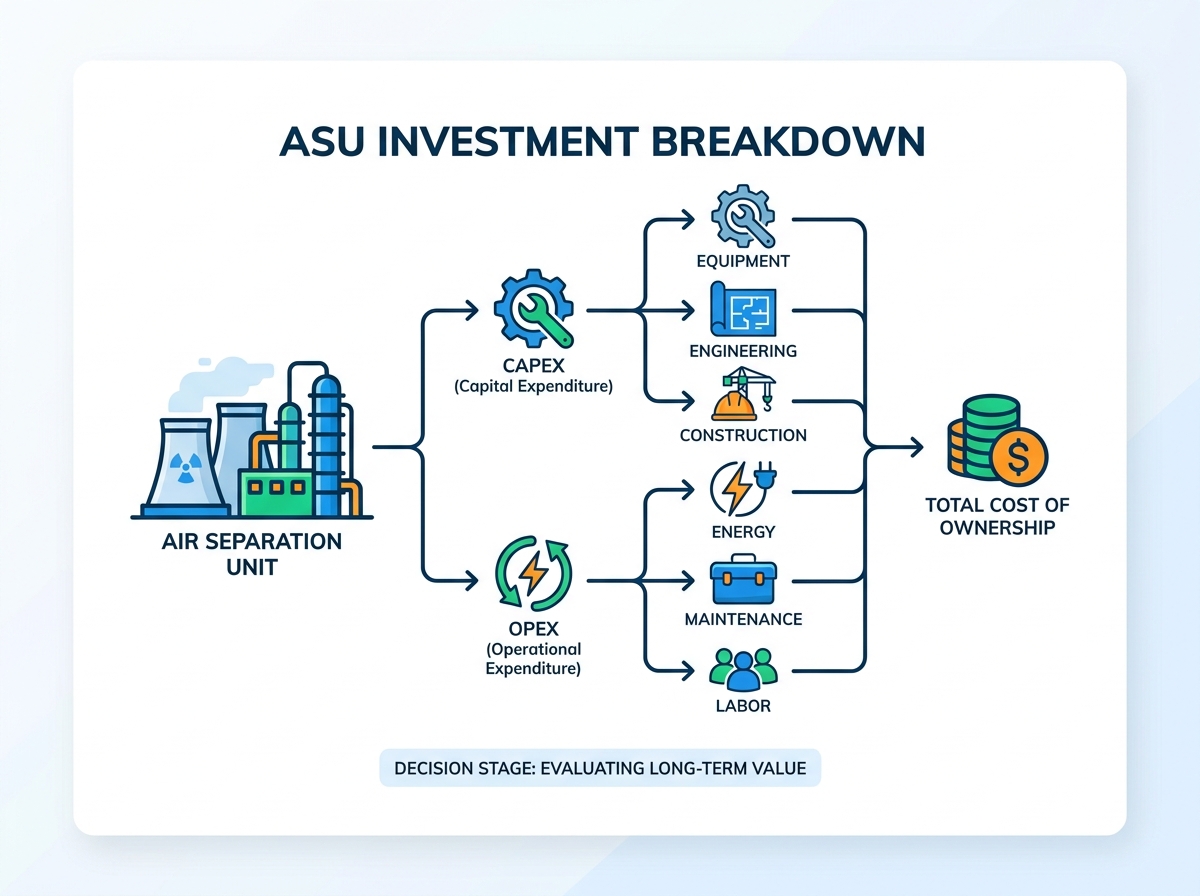
Evaluating the true air separation unit cost requires looking far beyond the initial equipment price tag. A comprehensive analysis must account for long-term energy consumption, maintenance cycles, and facility integration to determine true financial viability. The initial capital outlay is just the beginning of the financial picture. Power consumption, routine maintenance, and infrastructure upgrades will ultimately dictate the long-term success and profitability of the installation.
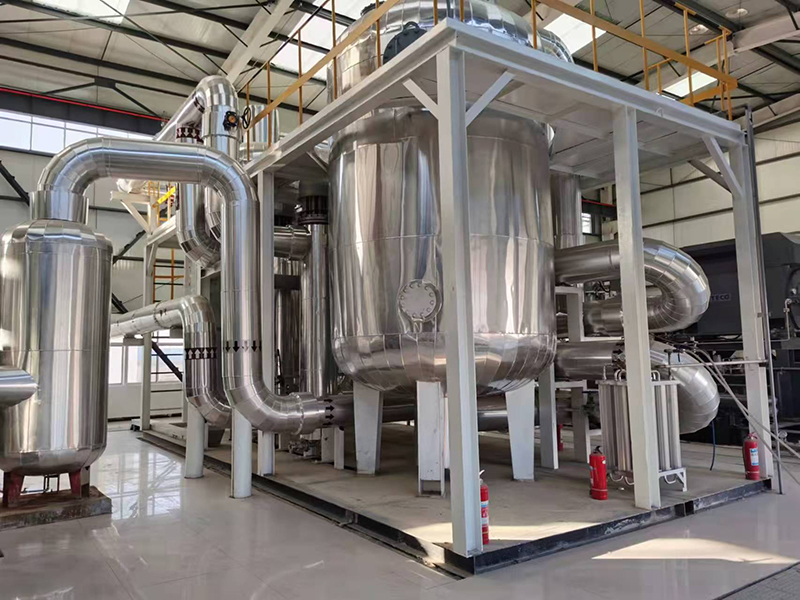
CAPEX vs. OPEX Imbalance: Initial equipment and installation (CAPEX) typically represent only 20-30% of the lifecycle cost, while energy consumption (OPEX) dictates long-term financial viability.
Technology Dictates Price: The choice between Cryogenic Distillation and Pressure Swing Adsorption (PSA/VPSA) drastically alters the baseline investment, driven entirely by required purity levels and volume (Tons Per Day - TPD).
The "Make vs. Buy" Threshold: On-site ASU investment generally yields a positive ROI when daily gas consumption exceeds specific volume thresholds, offsetting the premium of liquid delivery logistics.
Alternative Financing (BOO/BOOT): Companies can mitigate high upfront air separation unit cost by utilizing Build-Own-Operate (BOO) contracts, converting capital expenditure into predictable operational expense.
Hidden Implementation Costs: Site preparation, high-voltage electrical infrastructure upgrades, and cooling water systems frequently add 15-25% to the base equipment cost.
Table of Contents
The initial investment for an on-site gas generation facility involves several major heavy industrial components. Core process equipment includes massive compressor packages, specifically the main air compressor and booster compressors. You also have to factor in molecular sieve adsorbers for purification, main heat exchangers, cold boxes housing the distillation columns, and precision expansion turbines. These components require specialized manufacturing and long lead times.
Balance of Plant (BOP) systems add significant expense to the project scope. You need storage vessels for liquid oxygen and nitrogen, backup vaporizers to ensure uninterrupted supply, product compression stations, extensive interconnecting piping, and sophisticated control systems like PLCs or DCS. Utility infrastructure integration requires high-voltage electrical substations, cooling towers, water treatment plants, and instrument air systems. Furthermore, engineering and project management costs cover process design, civil engineering, procurement, transportation of oversized equipment, installation labor, and commissioning fees.
Electricity consumption stands as the absolute dominant OPEX driver, representing the vast majority of ongoing operational costs. Evaluating specific power consumption metrics, measured in kilowatt-hours per normal cubic meter of gas produced, is critical for assessing long-term efficiency. Maintenance and consumables form another continuous expense. This encompasses scheduled compressor overhauls, molecular sieve replacements, valve maintenance, and cooling water treatment chemicals.
While modern automated plants require minimal on-site operators, cost models must account for remote monitoring services and specialized technical support. Maintaining an annualized spare parts inventory for critical components is necessary to prevent catastrophic downtime. You cannot afford to wait weeks for a replacement expansion turbine bearing or specialized compressor seal when your primary production line depends on continuous gas flow.
Economies of scale play a non-linear role in plant sizing. Doubling the capacity of the facility does not double the equipment or installation cost. Facility managers must weigh the cost trade-offs between sizing a plant for peak load requirements versus sizing for baseline demand while integrating liquid storage buffers to handle sudden demand spikes. Over-sizing the plant leads to inefficient turndown operations, while under-sizing forces reliance on expensive backup liquid deliveries.
The required purity level drastically impacts the overall investment and engineering complexity. Generating industrial-grade oxygen or nitrogen at standard purity using PSA or VPSA technology requires a completely different equipment footprint than producing ultra-high purity gas via cryogenic distillation. Additionally, incorporating Argon recovery increases the column height, cold box complexity, and overall CAPEX significantly, though it yields a highly valuable byproduct that can offset operational expenses.
Producing liquid gas carries a massive energy and equipment premium. Liquefaction requires additional heavy-duty compressors, liquefier units, and high-vacuum insulated cryogenic storage tanks. Direct gaseous pipeline delivery is far more efficient for immediate on-site consumption. If your process does not strictly require liquid gas, avoiding the liquefaction step will drastically reduce both your initial capital outlay and your ongoing power consumption.
Site location directly influences equipment sizing and structural engineering requirements. Lower air density at high altitudes or high ambient temperatures reduces compressor efficiency. This necessitates larger, more robust compressors to achieve the desired output. Furthermore, tall distillation columns require costly structural engineering premiums, including deep foundation piling, in active seismic zones or coastal high-wind environments.
Cryogenic plants target high-volume applications requiring ultra-high purity, multi-gas recovery, and liquid production capabilities. They carry the highest initial CAPEX and the longest project execution timeline, often spanning 18 to 24 months from design to commissioning. However, they offer the lowest energy cost per unit of gas at massive scales, making them the only viable choice for heavy industrial consumers.
PSA and VPSA systems are ideal for low to medium volume single-gas generation at industrial-grade purity. They feature moderate initial CAPEX, modular rapid deployment, and lower site preparation costs. The trade-off is higher specific power consumption per unit of gas compared to large-scale cryogenic units. These skid-mounted systems can often be installed and commissioned in a fraction of the time required for a cryogenic plant.
Membrane technology suits low-volume, low-purity nitrogen applications like purging and blanketing. It offers the lowest CAPEX and footprint with near-zero maintenance requirements. However, it suffers from the highest energy consumption per unit of gas produced. Membranes degrade over time and require periodic replacement, which must be factored into the long-term operational budget.
Technology | Typical Capacity Range | Relative CAPEX | Relative OPEX (per unit gas) | Expected Lifespan |
|---|---|---|---|---|
Cryogenic | >100 TPD | Very High | Low (at scale) | 25-30+ Years |
VPSA | 10 - 100 TPD | Moderate | Moderate | 15-20 Years |
PSA | <20 TPD | Low-Moderate | High | 10-15 Years |
Membrane | <5 TPD | Low | Very High | 5-10 Years |
An outright purchase offers complete asset control and potential tax depreciation benefits. You own the equipment and dictate the operational schedule. However, it requires maximum upfront capital and internalizes all operational and maintenance risks. Your internal maintenance team must be fully trained on high-speed rotating equipment and cryogenic safety protocols.
BOO contracts require zero upfront capital, transferring technology, operational risk, and maintenance responsibilities entirely to the industrial gas vendor. The vendor builds the plant on your site and sells you the gas over the fence. The downside involves long-term contractual commitments with strict clauses that mandate payment even if your facility's gas demand drops unexpectedly.
The BOOT model mitigates initial operational risk while ensuring long-term asset ownership. The vendor operates the plant for a set period before transferring ownership to your facility. This involves complex contract negotiation and a potential premium on the transition cost at the end of the term, but it allows your team to learn the operational nuances before taking full control.
Civil engineering requirements often include heavy-duty concrete foundations designed specifically to handle the dynamic vibration loads of large reciprocating or centrifugal compressors. You cannot simply place these machines on a standard warehouse floor. Tall cryogenic cold boxes may also require costly deep piling for stability, especially in areas with poor soil bearing capacity.
Running dedicated high-voltage power lines and installing step-down transformers to handle the massive starting currents of large motors can add significant hidden costs to the project. If your current electrical substation lacks the capacity to handle a multi-megawatt compressor load, the required grid upgrades can delay the project by months and severely impact the budget.
Local zoning, environmental impact studies, noise mitigation enclosures, and pressure vessel certifications all contribute to the final implementation cost and timeline. Compressor acoustic silencers are often mandatory to meet local noise ordinances. Navigating the regulatory landscape requires experienced project managers who understand industrial gas safety standards.

Calculate the true fully loaded cost of bulk liquid or cylinder supply. This includes the base molecule cost, delivery fuel surcharges, hazardous materials fees, tank rental, and vapor losses through boil-off. Many facilities underestimate the amount of gas lost to the atmosphere when liquid tanks sit idle.
Construct a comprehensive cash flow model incorporating the selected procurement model, local utility power rates, projected maintenance intervals, and emergency backup liquid gas supply agreements. You must account for scheduled downtime during major compressor overhauls and ensure you have enough backup storage to keep your primary production running.
Calculate Net Present Value and Internal Rate of Return to determine the payback period. Quantify non-financial risk mitigations, such as the complete elimination of supply chain disruption, reduction of heavy site traffic from liquid truck deliveries, and carbon footprint reduction achieved by eliminating long-distance liquid transportation.
Choosing the right air separation unit is not simply about minimizing the initial investment—it is about optimizing lifecycle costs, operational efficiency, and long-term reliability. A well-planned ASU project can significantly reduce operating expenses while ensuring a stable and secure industrial gas supply.
At Zhejiang Jinhua, we provide advanced industrial gas equipment and customized air separation solutions for customers worldwide. Our experienced engineering team focuses on energy-efficient system design, helping businesses reduce operating costs, improve productivity, and maximize the long-term value of their investment.
Before selecting an air separation solution, compare suppliers based on energy efficiency, lifecycle operating costs, technical support, and project experience—not just the equipment price.
A: The investment depends heavily on production capacity, purity requirements, and geographic location. Small-scale plants require a moderate capital outlay, while world-scale industrial facilities producing massive daily tonnages demand a highly significant financial commitment. Engineering complexity, site preparation, and local labor rates also drive the final expenditure.
A: On-site generation typically becomes more economical when consumption exceeds specific daily thresholds, often around 15 to 20 tons per day for oxygen. Continuous high-flow nitrogen requirements also justify the shift from bulk liquid deliveries to dedicated on-site production facilities.
A: Electrical power constitutes the vast majority of operational expenses. Even a minor fractional fluctuation in power rates per kilowatt-hour can dramatically alter the payback period. Securing favorable, long-term power purchase agreements is a mandatory step before finalizing any plant investment.
A: Under a Build-Own-Operate agreement, the buyer must pay for a minimum monthly volume of gas whether they consume it or not. This contractual mechanism can heavily penalize facilities with highly variable production rates or unexpected seasonal operational downtime.
A: Maintenance involves minor annual inspection shutdowns and major turnaround cycles every three to five years. These turnarounds cover compressor overhauls, valve replacements, and instrument calibration. You must budget for both the direct maintenance labor and the operational downtime required to execute the work.


