Views: 0 Author: Site Editor Publish Time: 2026-11-23 Origin: Site


A practical guide to comparing air separation unit quotations, from people who build them.
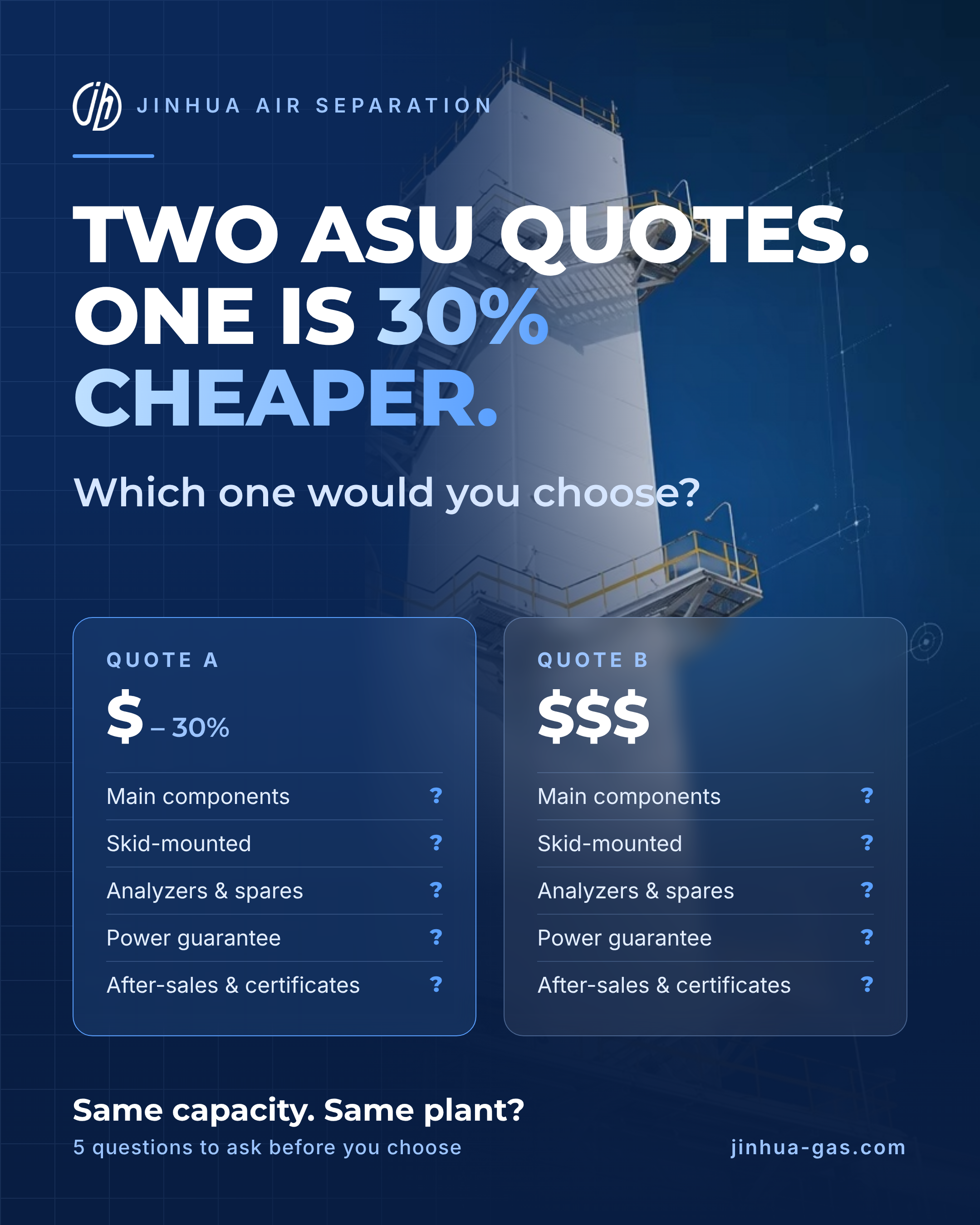
Imagine two quotations on your desk for the same 1,000 Nm³/h oxygen plant. Same capacity, same purity, and one is 30% cheaper.
Choosing the cheaper one is a natural first instinct. Price matters, and you should question it.
But in our experience, a gap that big is rarely about one supplier being "cheap" and the other "expensive." Usually, the two quotes simply aren't describing the same plant. One might include analyzers, spare parts and a factory-tested skid. The other might list those separately, or leave them for the buyer to arrange. Neither is wrong. They just need to be compared on the same basis.
After 25+ years and plants in more than 50 countries, here's the checklist we'd give any buyer, whether you choose us or not.
An ASU isn't a single machine. It's a team of components working together:
Part | What it does | Why it matters to you |
|---|---|---|
Air compressor | Takes in and compresses air | Uses the most power, so it shapes your electricity bill for years |
Pre-cooling | Cools the compressed air | Keeps the next stages stable |
Purification (molecular sieve) | Removes moisture and CO₂ | Protects the cold box and keeps the plant safe |
Cold box | Separates O₂, N₂ and Ar | The heart of the plant. Purity, output and stability start here |
Expansion turbine | Produces the cold the process needs | Affects liquid production and efficiency |
Compressors / pumps / tanks | Deliver your gas or liquid | Sometimes in the supplier's scope, sometimes in the buyer's |
Controls & analyzers | Run the plant and measure purity | Needed for automatic operation and proving quality |
Valves, piping, electrical | Connect everything | Quality here shows up as reliability |
With that in mind, here are 5 questions that make any comparison clear.
Some suppliers manufacture the core equipment themselves. Others work as integrators, sourcing major parts from specialist subcontractors. Both models exist. What matters is that you know which one you're buying, because it affects quality control and who takes responsibility if something needs fixing.
Worth asking:
Which parts are made in your own factory?
Could you share the brand list for the compressor, PLC/DCS, cryogenic valves and analyzers?
How are welds inspected?
✅ At Jinhua: we were founded in 2001 by senior engineers from Hangyang. We manufacture the core of the plant ourselves: the purification system and distillation columns, plus coolers and control cabinets. Where another company is the specialist, we use trusted brands: Turbo / Himile compressors and Siemens PLC control. Every component has its own ID tag so it can be traced, and every weld passes X-ray inspection and pressure testing.
There are two common ways a plant arrives on site:
Skid-mounted: pre-assembled, pre-piped and pre-wired. Site work is mostly connection and commissioning.
Field-assembled: shipped in parts and built on site. This can work well, but it needs more site labor, time and supervision, and that cost often sits in the buyer's budget rather than the quotation.
Neither choice is right or wrong. Just make sure you compare the total installed cost, not only the equipment price.
Also worth asking: Is the plant test-run in your factory? Will I receive a performance certificate?
✅ At Jinhua: we finish complex work in the factory, not on your site. Our plants are highly integrated and skid-mounted, with wiring done in-house. Each plant goes through a full integrated test run, with purity and dew point checked, and ships with a Plant Performance Certificate.
This is where most price differences come from. A simple checklist helps:
Item | Included? |
|---|---|
Online analyzers (purity, dew point, CO₂) | |
Commissioning spares and 2-year operating spares | |
First fill of molecular sieve, alumina, oil | |
Perlite / cold box insulation | |
Storage tanks, vaporizers, filling system | |
Interconnecting piping and cables | |
Installation supervision (how many engineers, how many days?) | |
Operator training | |
Drawings and manuals (P&ID, GA, O&M) |
Then look at the buyer's scope section: foundations, buildings, power supply, cooling water, cranes, site labor and permits.
☞ Tip: put every quote into one table with the same scope, adding the cost of anything that's excluded. Often the gap between quotes shrinks, or even reverses.
A strong proposal guarantees what matters, and says what happens if it isn't met:
Capacity (Nm³/h or TPD)
Purity
Power consumption (kWh per Nm³ O₂)
Penalties or remedies
Why power consumption deserves attention: an ASU may run around 8,000 hours a year for 15 to 25 years. Over that time, electricity usually costs far more than the equipment itself. A small difference in efficiency can matter more than the difference in purchase price.
➜ The best comparison isn't purchase price. It's lifecycle cost.
Your plant will run for decades, so it's worth knowing:
How quickly the supplier responds when you need help
Whether engineers can come to your site
How long spare parts take to arrive
Whether after-sales is designed around your costs or theirs
✅ At Jinhua: we offer 24/7 technical support for the life of the plant, on-site engineer support and hands-on operator training. First-year preventive maintenance is free, with quarterly remote diagnostics. Our after-sales service is certified, and it's built to keep your costs low, not to be a revenue stream.
Requirements depend on where your plant will be installed:
Region | What to look for | What it shows |
|---|---|---|
China | TSG special equipment (pressure vessel) manufacturing license | The legal base for any Chinese manufacturer |
USA & international projects | ASME "U" stamp | Welding, inspection and QC meet a widely recognized international benchmark |
Europe | CE marking (Machinery Directive; PED for pressure equipment) | The product meets EU safety requirements |
Everywhere | ISO 9001 / 14001 / 45001 | Quality, environmental and safety management |
Three simple checks:
Is it valid? Look at the expiry date. Many certificates can be verified online.
Is it in the supplier's own name and factory? It should match the factory that will build your plant.
Does the scope cover your equipment? Every certificate lists exactly what it covers.
✅ At Jinhua, we're certified at three levels: China, USA and EU.
China Special Equipment Production License (TS), pressure vessel manufacturing with design rights
ASME "U" Certificate of Authorization, for pressure vessels built at our Longyou factory
CE conformity under the EU Machinery Directive for our ASO(N) air separation unit series
ISO 9001 / 14001 / 45001, certified after-sales service, National High-Tech Enterprise, AAA credit rating and 50+ patents and certificates
Who makes the main components? Ask for the brand list.
Skid-mounted and factory-tested? Ask for the performance certificate.
Same scope? Compare every quote line by line.
What's guaranteed? Especially power consumption.
After-sales and certificates. Valid, in the supplier's own name, and covering your equipment.
Sometimes yes, sometimes no. It depends on what's inside the quote. Our goal isn't to be the cheapest line on your spreadsheet. It's to be the plant you're still happy with 15 years from now.
25+ years of experience, founded by senior engineers from Hangyang
Certified at three levels: China TS, USA ASME "U", EU CE
50 to 10,000 Nm³/h: small and mid-size plants are our core business
300+ customers in 50+ countries, including a plant running in the Turkmenistan desert
Core components made in-house, skid-mounted and factory-tested
Lifetime 24/7 support and certified after-sales service
Send them over. We're happy to help you line them up side by side, so you can make the decision that's right for your project, whichever supplier you choose.
Julia Nguyen, International Business Development Manager
☎ WeChat: 19557152870 (Julia)
✉ Email: julia@hzjhkf.com
✆ WhatsApp: scan the QR code below