
Views: 0 Author: Site Editor Publish Time: 2026-10-22 Origin: Site


Industrial gas production demands massive energy input. Power consumption often represents the largest single operating expense for industrial gas facilities. Facility managers face compounding pressures from rising global energy costs, strict emissions regulations, and margin compression. These factors force operators to extract maximum yield from existing infrastructure. You cannot rely on outdated operational baselines if you want to remain competitive. We need to evaluate and implement efficiency upgrades systematically. This technical roadmap covers mechanical retrofits, inlet air quality management, and advanced process controls. You can execute these improvements without compromising gas purity or operational safety. By targeting specific thermodynamic bottlenecks, plants can lower specific power and improve overall yield.
Compressor Optimization is Paramount: The Main Air Compressor (MAC) accounts for the majority of power draw; integrating Variable Frequency Drives (VFDs) and optimizing inlet guide vanes offer the highest immediate ROI.
Inlet Air Quality Directly Impacts Power Draw: Upgrading intake filtration and managing ambient moisture at the source prevents pressure drops and protects downstream equipment, significantly reducing energy use.
Advanced Process Control (APC) Drives Yield: Transitioning from reactive manual tuning to predictive APC minimizes process variance, allowing plants to operate closer to thermodynamic limits.
Thermal Integration Reduces Waste: Minimizing the temperature approach in main heat exchangers and optimizing expansion turbine recovery are critical for lowering specific power consumption.
Pre-Purification Unit (PPU) Tuning: Optimizing regeneration cycles in molecular sieves reduces thermal energy waste and extends desiccant lifespan.
Table of Contents
Improving air separation efficiency requires accurate energy monitoring, optimized gas purity, and effective process control. Plant operators should evaluate energy consumption across compression, purification, cooling, and gas separation to identify opportunities for improvement.

Specific power consumption is a key indicator of air separation plant efficiency. It measures the electricity required to produce a unit of gas, commonly expressed in kWh/Nm³.
Lower specific power generally indicates better energy performance when comparing equivalent products and operating conditions.
Operators should track electricity consumption, gas output, and operating hours to establish a reliable performance baseline.
Energy audits help identify inefficiencies in compressors, heat exchangers, purification systems, and distillation columns.
Key parameters include:
Compressor power consumption.
Air and gas flow rates.
Operating temperatures and pressures.
Heat exchanger performance.
Product purity and recovery rates.
For large-scale oxygen and nitrogen production, Jinhua Gas offers Advanced Cryogenic Air Separation Units with integrated compression, purification, and process control systems.
Higher gas purity does not always mean better operating efficiency.
Producing gas beyond the required specification may increase energy consumption or reduce recovery, depending on the separation process.
Plants should maintain the required purity while optimizing flow rates, pressures, and separation conditions.
For steel manufacturing, Jinhua Gas's High-Performance Cryogenic Air Separation Plant supports high-purity oxygen and nitrogen production for continuous industrial applications.
Stable operation helps reduce unnecessary energy losses and equipment wear.
Regular maintenance, automated monitoring, and appropriate capacity control can improve overall performance.
Operators should also review production demand and avoid frequent operating changes that reduce process stability.
Performance Indicator | What It Measures | Why It Matters |
|---|---|---|
Specific Power Consumption | kWh per Nm³ of gas | Evaluates energy efficiency |
Gas Purity | Product composition | Confirms specification compliance |
Gas Recovery Rate | Useful product recovered | Measures separation performance |
Compressor Efficiency | Power used for compression | Identifies major energy losses |
Heat Exchanger Performance | Heat transfer effectiveness | Influences cryogenic efficiency |
Plant Availability | Reliable operating time | Supports continuous gas supply |
Performance should be compared using consistent product definitions, operating conditions, and measurement boundaries.
Cryogenic distillation, adsorption, and membrane separation use different methods to produce oxygen and nitrogen. Their energy requirements depend on gas purity, capacity, pressure, and operating conditions.
Cryogenic air separation uses low temperatures and distillation to separate oxygen, nitrogen, and potentially argon from atmospheric air.
It is widely used for large-scale production and applications requiring high-purity gases.
Energy efficiency depends on compressor performance, heat exchanger effectiveness, cold box insulation, and distillation control.
Jinhua Gas provides customized Air Separation Plant systems for large-scale industrial gas production.
PSA technology separates gases using selective adsorption under changing pressure conditions.
It is commonly used for on-site oxygen or nitrogen generation where capacity and purity requirements fit the technology.
PSA system efficiency depends on compressor performance, adsorption cycle design, and adsorbent condition.
Explore Jinhua Gas's Oxygen Plant solutions for industrial oxygen production options, including PSA and cryogenic systems.
VSA systems use vacuum regeneration to release adsorbed gases during the separation cycle.
This technology may offer energy advantages for selected oxygen production applications. However, efficiency depends on vacuum equipment, operating pressure, and production requirements.
PSA and VSA should be compared through project-specific engineering evaluations.
Membrane systems separate gases through differences in membrane permeability.
They are commonly used for selected nitrogen generation and gas enrichment applications, particularly when moderate purity and compact equipment are appropriate.
Membrane performance depends on feed-air quality, required purity, operating pressure, and recovery rate.
Technology | Common Applications | Main Energy Requirement | Key Advantage |
|---|---|---|---|
Cryogenic Separation | Large-scale oxygen, nitrogen, argon | Compression and refrigeration | High capacity and purity |
PSA | On-site oxygen or nitrogen | Air compression | Modular operation |
VSA | Selected oxygen production | Vacuum and air-moving equipment | Potential efficiency benefits |
Membrane Separation | Nitrogen generation, gas enrichment | Feed-gas compression | Compact and relatively simple design |
The most efficient air separation technology depends on actual production requirements.
Buyers should evaluate:
Required oxygen or nitrogen capacity.
Product purity and delivery pressure.
Daily operating hours and load variation.
Available space and utilities.
Electricity costs and maintenance requirements.
Initial equipment investment and long-term operating costs.
For industrial projects, Jinhua Gas provides customized oxygen, nitrogen, and air separation solutions based on plant capacity, purity requirements, and operating conditio
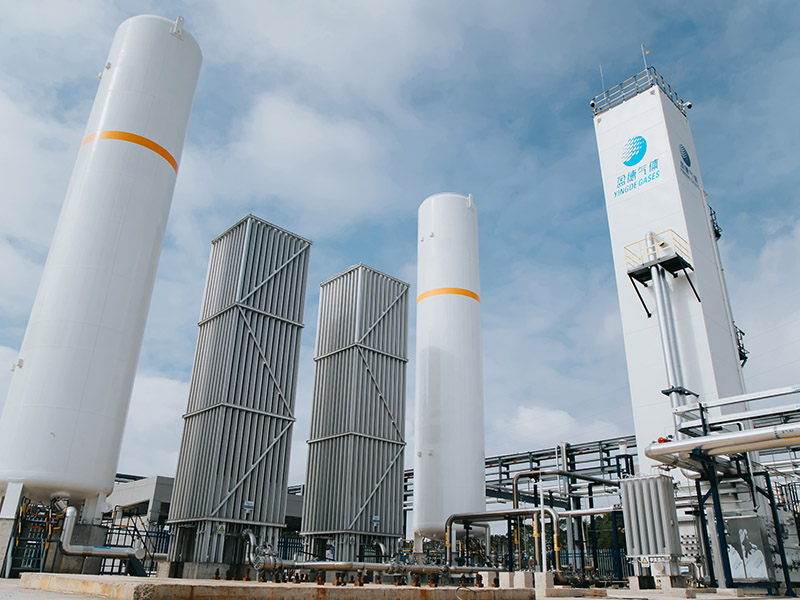
Improving air separation plant efficiency starts with reducing compressor energy consumption, optimizing purification, and maintaining stable cryogenic performance. Regular monitoring helps operators identify unnecessary energy losses before investing in major upgrades.
Clean inlet air helps maintain compressor efficiency and equipment reliability. Dust, moisture, and industrial contaminants can increase filter resistance and affect downstream components.
Locate air intakes away from major contamination sources. Monitor filter differential pressure and replace filters according to operating conditions and manufacturer recommendations.
The main air compressor is a major energy consumer in cryogenic air separation plants.
Efficiency improvements may include compressor maintenance, intercooler cleaning, and appropriate capacity control. Variable Frequency Drives (VFDs) can improve part-load performance in suitable compressor configurations.
However, expected savings depend on compressor design and operating conditions.
For industrial oxygen and nitrogen production, Jinhua Gas offers Advanced Cryogenic Air Separation Units incorporating compression, purification, and automated process control.
Moisture and carbon dioxide must be removed before air enters the cryogenic cold box.
Direct contact coolers and pre-purification units help reduce contaminants that could freeze inside low-temperature equipment.
Maintain moisture separators, drainage systems, and molecular sieve beds. Monitor regeneration performance to avoid unnecessary heating energy and premature adsorbent deterioration.
Efficient heat exchange reduces refrigeration losses in cryogenic air separation systems.
Monitor temperature differences, pressure drops, and operating stability across the main heat exchanger.
Unexpected performance changes may indicate flow imbalance, fouling, or other operating issues requiring technical investigation.
Turboexpanders provide refrigeration for cryogenic distillation. Their efficiency affects the cooling available to the separation process.
Modern expander designs may improve energy recovery or refrigeration efficiency, depending on the plant configuration.
Evaluate expander upgrades through engineering calculations rather than assuming a fixed energy-saving percentage.
Advanced Process Control (APC) helps coordinate plant operating parameters, particularly when oxygen and nitrogen demand changes.
Suitable control systems can improve load management, compressor operation, and overall process stability.
Jinhua Gas's High-Performance Cryogenic Air Separation Plant for Steel Manufacturing is designed for continuous industrial gas supply and incorporates automated process control.
Proper control of reflux, pressure, and flow rates supports efficient gas separation.
Operating parameters should be adjusted according to required oxygen and nitrogen purity, production capacity, and equipment limitations.
Any changes must maintain stable operation and prevent off-specification gas production.
Molecular sieve regeneration consumes energy and requires careful cycle management.
Operators should review regeneration temperature, gas flow, and cycle duration based on actual adsorbent performance.
Where supported by the plant design, suitable dry waste nitrogen streams may be used for regeneration.
Optimization must preserve adequate moisture and carbon dioxide removal.
Air separation plant upgrades should balance capital expenditure (CAPEX) with long-term operating expenditure (OPEX).
Some improvements require only maintenance or control adjustments, while major compressor or cold box upgrades involve higher investment.
For existing plants, begin with operational improvements before considering major equipment replacement.
Typical opportunities include filtration upgrades, compressor maintenance, heat exchanger inspection, and control-system optimization.
If existing equipment cannot meet production, purity, or efficiency requirements economically, a new air separation plant may be worth evaluating.
Jinhua Gas provides customized Air Separation Plant solutions for industrial oxygen, nitrogen, and argon production.
Upgrade Option | Relative Investment | Main Benefit | Best Application |
|---|---|---|---|
Intake Filtration | Low | Reduced pressure loss | Plants with high dust loads |
Compressor Maintenance | Low–Moderate | Improved compression efficiency | Existing plants |
Control Optimization | Moderate | Better load management | Variable gas demand |
Heat Exchanger Maintenance | Depends on condition | Improved thermal performance | Cryogenic ASUs |
Expander Upgrade | High | Potential refrigeration or energy benefits | Suitable legacy systems |
Complete Plant Replacement | Very High | New capacity and system efficiency | Aging or undersized plants |
Investment levels and savings depend on plant conditions and engineering assessments.
Upgrade priorities should reflect production scale and operating hours.
Large air separation plants may justify advanced automation and major mechanical upgrades because small improvements can produce significant annual energy savings.
Smaller plants may benefit more from reliable operation, preventive maintenance, and straightforward process adjustments.
Upgrade planning should protect industrial gas supply continuity.
Schedule major maintenance during planned shutdowns and coordinate work with downstream gas users.
Where suitable backup storage and vaporization systems are available, verify their capacity and operating readiness before shutdown.
Changes to compressor operation, distillation controls, or expander settings may affect gas purity.
Test modifications before implementation and introduce changes under approved operating procedures.
Continuous product-quality monitoring helps detect deviations and supports stable production.
Cryogenic air separation equipment involves oxygen-enrichment, oxygen-deficiency, high-pressure, and low-temperature hazards.
Upgrade projects should follow applicable engineering standards and site safety procedures.
Important controls include oxygen-compatible materials, appropriate oxygen cleaning, leak testing, ventilation, gas monitoring, and safe isolation procedures.
All modifications should be reviewed and approved by qualified personnel before commissioning.
Improving energy efficiency requires a combination of equipment maintenance, process control, and engineering optimization.
For new installations or major system upgrades, Jinhua Gas provides industrial air separation equipment for oxygen, nitrogen, and argon production.
Contact Jinhua Gas to discuss plant capacity, gas purity, energy consumption, and customized air separation solutions.
Improving facility efficiency remains a continuous, data-driven process. It is not a one-time mechanical fix. Control system upgrades and routine intake maintenance provide the fastest return on investment. Mechanical retrofits, such as compressor overhauls and expander replacements, offer the deepest long-term savings. You must balance immediate operational tweaks with strategic capital investments to maintain a competitive specific power baseline. Relying on outdated equipment guarantees shrinking margins as energy costs climb.
Evaluate engineering partners based on verified track records. Select vendors who demonstrate success with your specific plant scale and technology type. Do not hire a vendor experienced only in small PSA systems to retrofit a mega-scale cryogenic cold box. Demand case studies showing verified specific power reductions. A competent partner will prioritize thermodynamic audits over immediate hardware sales. They will analyze your operating data before recommending a single piece of equipment.
Take immediate action to secure your operational baseline. Follow these concrete steps:
Initiate a comprehensive exergy audit to identify primary thermodynamic bottlenecks across the compression and distillation stages.
Inspect current inlet filtration systems and record baseline differential pressure data to determine immediate replacement needs.
Begin a high-frequency data collection phase to map actual compressor power against ambient temperature swings.
Calibrate all purity analyzers to ensure you are not over-purifying your product and wasting reflux energy.
A: Specific power varies based on product mix and pressure requirements. For a modern, highly optimized cryogenic oxygen plant, specific power typically ranges between 0.35 and 0.45 kWh/Nm³ of gaseous oxygen. Plants producing high volumes of liquid products will have significantly higher specific power due to the massive refrigeration energy required for liquefaction.
A: High ambient temperatures reduce air density, forcing the compressor to work harder to move the same mass of air. High humidity increases the moisture load on the pre-purification unit, requiring more energy for desiccant regeneration. Poor inlet air quality fouls filters rapidly, creating pressure drops that directly increase the main air compressor's power consumption.
A: Upgrading to high-efficiency filtration reduces the initial pressure drop at the intake. The main air compressor must overcome this pressure drop before compressing the air. Lowering the intake resistance by just a few millibars translates to a direct, measurable reduction in the electrical shaft power required by the compressor motor.
A: Yes. APC systems utilize predictive models to adjust plant parameters dynamically. Instead of operators running the plant conservatively to avoid process upsets, APC pushes the plant closer to its thermodynamic limits. This reduces wasted compressor blow-off, optimizes reflux ratios, and typically yields a 3% to 8% reduction in overall energy costs.
A: Molecular sieves generally last between three to five years under normal operating conditions. Lifespan depends heavily on regeneration cycle tuning and protection from liquid water carryover. If the beds experience frequent water intrusion or excessive regeneration temperatures, the desiccant structure degrades rapidly, requiring premature replacement to maintain purification efficiency.
A: Cryogenic distillation is highly efficient for massive volumes and ultra-high purities, leveraging economies of scale. PSA is more energy-efficient for mid-scale, lower-purity applications because it avoids the extreme energy penalty of cryogenic refrigeration. However, PSA specific power scales poorly for massive tonnage requirements compared to cryogenic plants.
A: The temperature approach measures the efficiency of heat transfer between warm and cold streams. A wider temperature approach means refrigeration is wasted and not recovered effectively. This forces the expansion turbine and main compressor to work harder to make up the lost cooling duty, directly increasing the plant's electrical operating expenses.


